Akebia quinata
Five-leaf Akebia, Chocolate Vine
Description
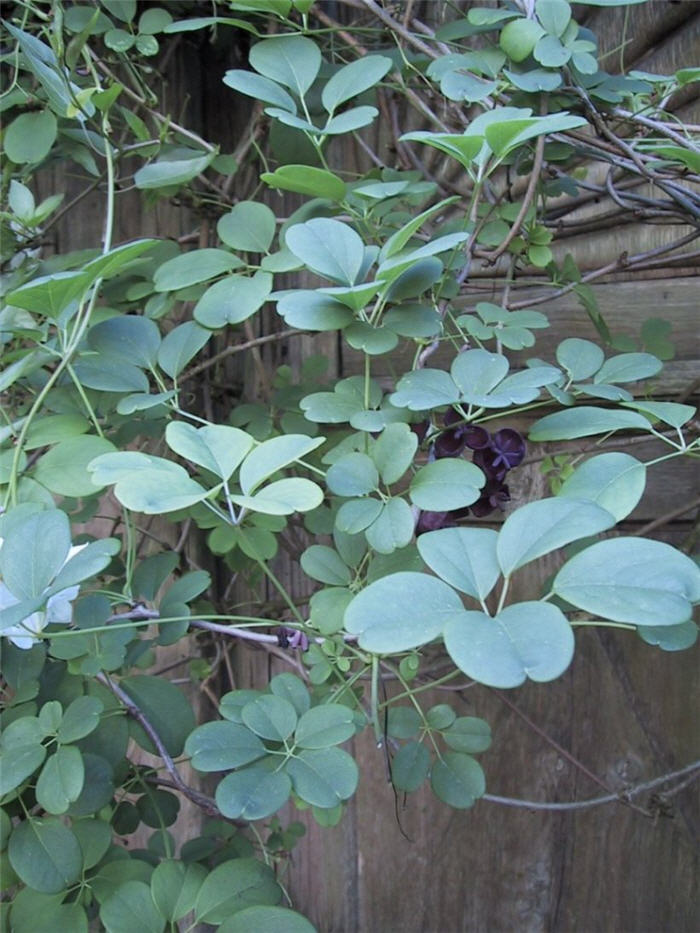
Akebia quinata, commonly called fiveleaf akebia, is a deciduous, twining, woody vine that rapidly grows to 20-40’. It produces compound, palmate leaves, each with 5 elliptic to oblong-obovate leaflets (1-3” long) which are dark green above and glaucous below. Small, chocolate-purple flowers bloom in drooping axillary racemes in spring. Flowers are often hidden by the foliage, but are quite interesting on close inspection and have a pleasant fragrance. Flowers give way to sausage-shaped, violet fruit pods (to 4” long) which split open in fall to reveal small black seeds imbedded in a whitish pulp. The whitish pulp is edible. Native to China, Korea and Japan, but has escaped cultivation and naturalized in parts of the eastern U.S. Sometimes commonly called chocolate vine. Easily grown in most soils. Best in well-drained, sandy loams with regular moisture in full sun to part shade. Prefers full sun, but tolerates close to full shade. Also tolerates some drought. Needs a support structure upon which to grow unless grown as a ground cover. For best fruit production, plant more than one vine to facilitate good cross-pollination. Many experts recommend hand-pollination. Prune as needed in late spring after flowers appear. May be cut to the ground to renovate. Foliage is semi-evergreen in warm winter climates. Grows rapidly and can suffocate shrubs or other vegetation if not kept in check. Provides quick cover in sun or shade for trellises, fences, arbors, pergolas and walls. May also be sprawled over the ground as a ground cover to camouflage rock piles or old tree stumps or to provide soil stabilization for banks. An excellent ground cover for shady areas and woodland gardens.
Plant Type
Ground cover, Vine
Height Range
25-40'
Flower Color
Purple
Flower Season
Spring
Leaf Color
Dark Green
Bark Color
n/a
Fruit Color
Purple
Fruit Season
Fall
Sun
Full, Half, Shade
Water
Medium
Growth Rate
Fast
Soil Type
Sandy
Soil Condition
Well-drained
Soil pH
Acid, Neutral, Basic
Adverse Factors
Invasive
Design Styles
Japanese, Meadow, Tropical, Wild Garden, Woodland
Accenting Features
Fragrance, Showy Flowers
Seasonal Interest
Spring
Location Uses
Background, Patio, Walls / Fences
Special Uses
Cascade, Erosion Control, Hedge, Screen
Attracts Wildlife
n/a
Water Saving Tip:
Check the soil's moisture level before watering.
You can reduce your water use 20-50% by regularly checking the soil before watering.