Actinidia arguta
Bower Actinidia
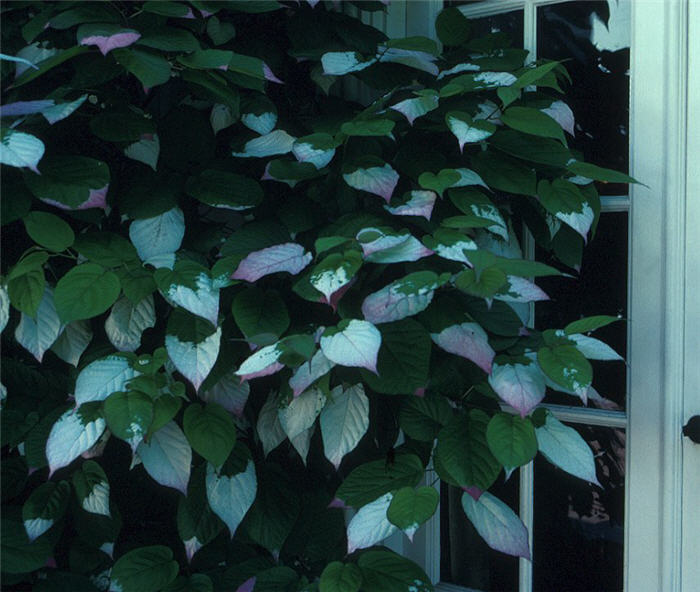
Description
Actinidia arguta, commonly known as hardy kiwi or tara vine, is a deciduous, fast-growing, twining woody vine that is typically grown for its attractive foliage and edible fruit. It is native to woodlands, mountain forests, streamsides and moist locations in eastern Asia, China and Japan. It grows to 25-30' or more, but growth is often so rampant that this vine, in its native habitat, may climb to as much as 100' into large trees. Broad-ovate to elliptic deep green leaves (3-5" long) emerge in spring, scented greenish-white flowers (to 3/4" long) bloom in June and edible grape-sized smooth-skinned fruits (to 1 1/4" long) mature in September-October. It tastes similar to, though slightly sweeter than, its larger-fruited relative, the true kiwi, Actinidia deliciosa, which can not be grown north of Zone 8. Grow in average, medium moisture, well-drained soil in full sun to part shade. Planting in infertile soil may temper somewhat rapid growth habit. Needs frequent pruning, including an annual winter pruning of each stem back to 8-10 buds and an annual summer pruning of excessively long shoots. This fast growing vine can be grown both for its beautiful foliage and its fruit. Rapid growth habit makes it suitable for a variety of cover-type uses such as on a trellis, arbor, patio overhead, fence, or wall.
Plant Type
Vine
Height Range
25-40'
Flower Color
White
Flower Season
Summer
Leaf Color
Dark Green
Bark Color
Tan
Fruit Color
Green, Yellow
Fruit Season
Fall
Sun
Full, Half
Water
Medium
Growth Rate
Fast
Soil Type
Sandy, Clay, Rocky
Soil Condition
Average, Poor, Well-drained, Moist
Soil pH
Acid, Neutral
Adverse Factors
Invasive
Design Styles
Tropical, Wild Garden
Accenting Features
Espalier
Seasonal Interest
Summer
Location Uses
Background, Patio, Walls / Fences
Special Uses
Screen
Attracts Wildlife
Birds
Water Saving Tip:
Change spray sprinklers to low-flow bubbler or drip systems. Shrubs and trees are ideal candidates for this type of irrigation because the water is applied directly to the root zones.